Why the Workday Ends at Different Hours Around the World
Why the workday ends at different hours around the world: understand how daylight, transport and shared schedules shape the handoff from work to rest.
The common mistake is to treat a colleague’s sign-off time as a verdict on how much they value work. It can turn an ordinary scheduling difference into a judgment about character. To understand why the workday ends at different hours around the world, look at the institutions and obligations that set the handoff, not at one person’s clock alone.
What does “the end of work” actually mean?
A workday can end at several different points: when paid duties stop, when a workplace closes, when a team expects no more replies, or when someone is free to turn attention elsewhere. Those boundaries may coincide, but they often do not.
A posted closing time, for instance, tells you when a business stops serving customers. It does not necessarily include the time needed to finish a handover, close a register or prepare for the next shift. In an office, the last message sent may be less meaningful than the team’s agreed response window.
It helps to name the boundary under discussion. Are you comparing contracted hours, customer service hours or the point at which a person is no longer expected to respond? Without that distinction, comparisons between places can confuse different kinds of time.
How do institutions shape the workday?
Work schedules are often coordinated with systems beyond the employer. School timetables, public-service hours, customer demand and shift handovers can all influence when a team begins or stops. These arrangements may shape a whole sector without telling you what every individual’s day looks like.
Some jobs must be present when other people need a service. A clinic, restaurant or transport operation may divide work into shifts, while a back-office team may align its hours with partner organizations. The resulting pattern reflects the work’s dependencies as much as any preference for an early or late day.
Institutions can also make one schedule easier to maintain than another. If a service closes before an employee’s shift ends, that person may need to arrange the task elsewhere or rely on someone else. The workday is then shaped by a practical mismatch between operating hours, not simply by an individual’s choice.
Why do daylight and season matter?
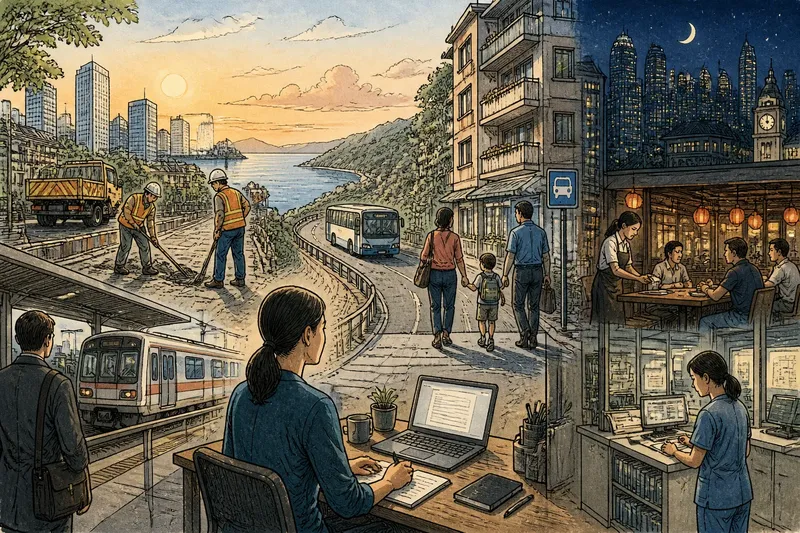
Daylight can influence the timing of outdoor work, travel and errands. A crew responsible for road maintenance may need light to do particular tasks; an office team may be affected more indirectly through school schedules or commuting. The same local clock time can therefore serve different purposes in different jobs.
Season changes the relationship between the clock and available light. A routine that fits long evenings may feel different when darkness arrives earlier, especially where work depends on being outdoors. But daylight is one condition among several, not a rule that dictates when everyone finishes.
Think of the clock as a kitchen timer: it marks a boundary, but it does not explain what is cooking or who is waiting to eat. To understand the schedule, you need the surrounding arrangement as well as the hour.
What does transport change?
Transport affects how much of the day remains after work. A shift can end before a train connection, a bus timetable can narrow the available choices, and road congestion can make departure time matter. These conditions influence the shape of a workday without making one schedule the right one for everyone.
Some journeys involve several linked tasks: leaving work, collecting a child, changing transit lines or reaching a service before it closes. A delay at one point can shift the whole sequence. For employers and colleagues, this matters most when deciding whether a meeting or handover fits before someone has to leave.
Say you manage a fictional design team with members in two cities. One colleague’s stated work window ends before your usual meeting time, and the team needs a decision on a shared draft. You propose an earlier meeting, send the draft beforehand, and reserve the later slot for people whose schedules allow it. The expected observable result is that the colleague can contribute before signing off, while the team still has a later option for follow-up.
How can you compare workday rhythms without stereotyping?
Compare arrangements, not presumed personalities. A particular workplace’s hours may reflect its customers, staffing model or coordination with another organization. They should not be treated as evidence about an entire city or culture.
- Observe a posted opening or closing time. If it describes customer access, treat it as a service boundary; if you need to know staff availability, check the work schedule instead.
- Check whether a team publishes response hours. If it names a response window, use that for routine messages; if it does not, agree on one rather than assuming replies are expected at all hours.
- Notice whether work is organized in shifts. If a handover is part of the role, schedule decisions around that exchange; if duties are individual, ask when the responsible person is available.
- Consider whether tasks depend on daylight. If a task must happen outdoors in usable light, plan around that constraint; if it is indoors, avoid treating daylight as the explanation without other evidence.
- Identify which organizations the team must coordinate with. If a partner’s operating hours set a deadline, align the shared task with them; if not, keep the team’s own schedule separate.
- Look for a stated exception or rotating arrangement. If hours vary by day or role, compare like with like; if the schedule is stable, describe that specific pattern without extending it to everyone nearby.
These checks keep the discussion focused on work design rather than private circumstances. For contractual obligations or local employment rules, consult the relevant employer policy or a qualified professional.
Which questions clarify why workdays end at different hours?
Does daylight determine when people finish work?
It can affect work that depends on outdoor conditions, but it does not set a universal finishing time. Job duties, services and shared schedules also matter.
Why do workplaces in the same city keep different hours?
They may serve different customers, coordinate with different organizations or use different staffing arrangements. A city can contain several workday patterns at once.
Does a business’s closing time show when its employees are free?
Not necessarily, because closing, cleanup and handover can be separate parts of the day. Check the relevant employee schedule or stated availability if coordination depends on it.
How can a team coordinate across different work windows?
Agree on a shared response window, identify a channel for urgent matters and schedule decisions when the people needed can attend. That makes the boundary explicit instead of treating one person’s hours as the default.
How should a team describe its own boundary?
Use language that identifies the arrangement without turning it into a cultural rule. “This team hands off customer requests before the evening shift” describes a work process. “People here stop working early” assigns a broad meaning that the schedule alone cannot support.
For teams working across places, make the practical terms explicit: when routine messages should receive a reply, which matters are urgent, and who covers a handover. Why the workday ends at different hours around the world is not answered by a single local custom. The clearest explanation comes from the actual commitments a schedule must serve—and the boundary each workplace has chosen to make visible.