The Seven-Day Week and the Shape of Shared Time
The seven-day week is a shared timekeeping convention, not a natural boundary. Learn how calendars shape public rhythms and make their assumptions visible.
The most common mistake about the seven-day week is treating it as a feature of nature, like sunrise. That can make its cost easy to overlook: a calendar may seem neutral while favoring one community’s gatherings, observances, or expectations. The seven-day week is a convention with a long history, but its origins and adoption are more complex than a single story of invention and spread.
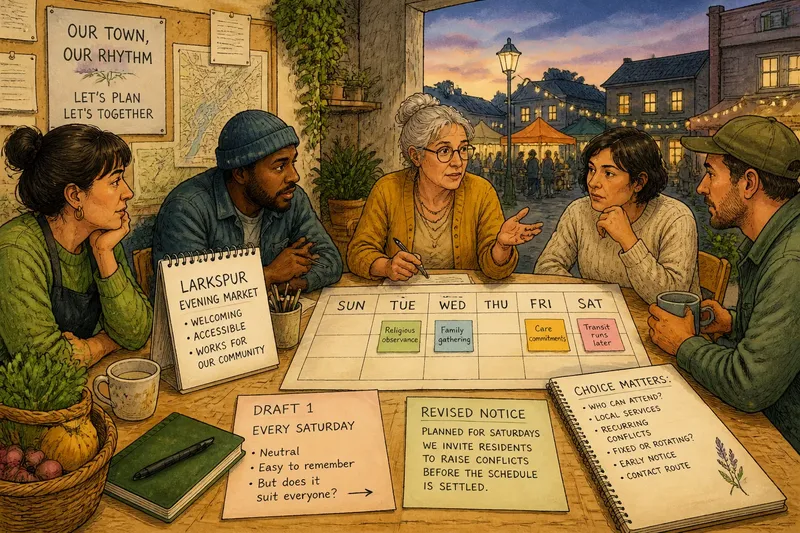
Imagine a clearly hypothetical town called Larkspur planning a seasonal evening market. The organizers want visitors to remember its schedule, but they also know a recurring day can collide with existing community practices. Their decision shows how a calendar can shape public life—not just record it.
Why does the seven-day week feel natural?
A week does not correspond neatly to a repeating pattern in the sky. Days follow Earth’s rotation, and months roughly track the Moon; the seven-day cycle is not a direct match for either. Its familiarity comes from repeated use. Once people and institutions organize plans around a cycle, that convention can feel as settled as a natural rhythm.
Seven-day cycles appear in several ancient traditions, but their histories are not identical, and the details of how particular practices influenced one another are complex. Religious observance, civic systems, and ordinary coordination all helped make the seven-day week familiar in many places. Other ways of dividing recurring time have also existed, so the present-day pattern should not be mistaken for a universal or inevitable arrangement.
In Larkspur, the market committee initially treats choosing a weekday as a minor administrative task. A shopkeeper points out a conflict with a recurring religious observance; a caregiver notes that family gatherings already center on another day. The question becomes less about finding an abstractly convenient date and more about deciding which existing rhythm will set the default.
How does a calendar make a shared promise?
A calendar lets people make plans in a form others can recognize. “Next Tuesday” can connect a delivery, a meeting, and a public notice without requiring everyone to negotiate the date from scratch. A recurring event offers a promise of return, and that promise works best when people understand the same cycle.
Shared timing can help coordinate people who do not share a religion, household, or occupation. Yet using the same weekly frame does not mean experiencing it in the same way. A day treated as a break by one person may be a workday for another, while someone else may reserve it for a recurring obligation.
In the hypothetical Larkspur, the committee first drafts a notice saying “every Saturday.” An organizer asks whether that wording implies the day suits everyone. They revise it to say the market is planned for Saturdays and invite residents to raise conflicts before the schedule is settled. The choice remains, but the notice no longer presents it as a neutral fact.
What cultural assumptions appear in a weekly calendar?
Days can carry religious meaning, civic importance, or little significance beyond their place in a routine. The meaning varies among traditions and communities. A common calendar can connect people without making the days mean the same thing to everyone.
Weekday names and numbering conventions also differ across languages and calendars. Some layouts place Monday first; others begin with Sunday. These choices do not change the dates, but they influence how readers scan a calendar and where they perceive the start of a weekly cycle.
In the invented Larkspur scenario, organizers notice that a printed calendar with Sunday at the left edge and a booking page beginning on Monday make the same dates look different. They add weekday names beside dates on public notices. The practical result is that residents can identify the intended day without having to infer it from the layout.
How can a town choose a public rhythm fairly?
No recurring day will suit everyone. Organizers can make a more considered choice by asking who is likely to attend, what local services are available, and whether the timing can change without becoming hard to follow. They should also distinguish a public event’s schedule from the question of when each worker or resident rests.
Say the hypothetical Larkspur committee has two proposed slots: Saturday evening, when transit runs later, and a weekday evening that avoids a recurring local observance. The committee publishes the first market date in advance and invites residents to flag conflicts. After receiving concerns, it chooses to alternate the two slots and lists each upcoming date with its weekday. The result is a recognizable notice format, though visitors must check the date rather than assume every market falls on the same day.
That arrangement has a trade-off. A fixed slot is easier to remember but can repeatedly exclude people with a standing conflict; alternating days broadens access but makes the pattern less simple. A shared schedule is like a key kept by many neighbors: useful for coordinating access, but not proof that every door opens onto the same life.
What should a public weekly schedule make clear?
- Week layout: Check which day appears first on printed and digital calendars. If the layouts differ, then label the first day on public materials; otherwise, keep the display consistent.
- Named date: Check whether each notice gives both the weekday and date. If it gives only “the weekend,” then replace that phrase with the specific day; otherwise, retain the clear date.
- Recurring conflicts: Check with residents whose work, care, or religious commitments may conflict. If a recurring group cannot attend, then consider another slot or a rotation; otherwise, keep the proposed time and state that it is a choice.
- Fixed or rotating pattern: Check whether the event always meets on one day. If it rotates, then list the actual upcoming dates; if it is fixed, then state the recurring day plainly.
- Contact route: Check whether residents can reach an organizer and understand what can still change. If the route or scope is unclear, then add a named contact method and clarify what is open for discussion; otherwise, keep the existing channel.
- Notice timing: Check whether people receive the schedule before they need to plan around it. If notice comes too late for residents to arrange attendance, then publish dates earlier; otherwise, keep the current notice cadence.
These checks do not require a community to renegotiate every date. They help separate the useful shared convention from the local choices built on top of it. In Larkspur, the seven-day cycle supplies a familiar frame; the committee remains responsible for explaining how its event uses that frame.
What do readers ask about the seven-day week?
Why are there seven days in a week?
The seven-day cycle developed through historical and cultural traditions rather than a direct astronomical cycle. Its history involves varied practices, and no single account explains every route by which it became familiar.
Does every culture begin the week on the same day?
No. Calendar layouts and local conventions can place different days at the start. Reading the weekday alongside the date helps avoid confusion.
Is the weekend the same everywhere?
No. Common days off vary among places, institutions, and individual schedules. Public notices should name the actual day instead of assuming a shared weekend.
Why keep a seven-day week if it is a convention?
A familiar cycle helps people coordinate recurring plans across households and institutions. Its usefulness comes from shared recognition, not from a claim that one arrangement fits everyone.
The seven-day week remains useful as a common reference point, not as an answer to every question about time. The search phrase seven-day week points to a shared convention whose meaning depends on how people use it. Naming the assumptions behind a schedule lets communities coordinate while leaving room for the different rhythms that a calendar cannot show.